Studies consistently show that the majority of large IT implementations run over budget, over schedule, or fail to deliver the expected benefits. The numbers vary depending on who's measuring, but the direction is always the same: most of these projects don't go the way they were supposed to.
And yet, most organizations respond to a failed implementation the same way: they blame the vendor, or the software, or the integration complexity. Then they start over with a different system — and the same thing happens.
The five real reasons IT implementations fail
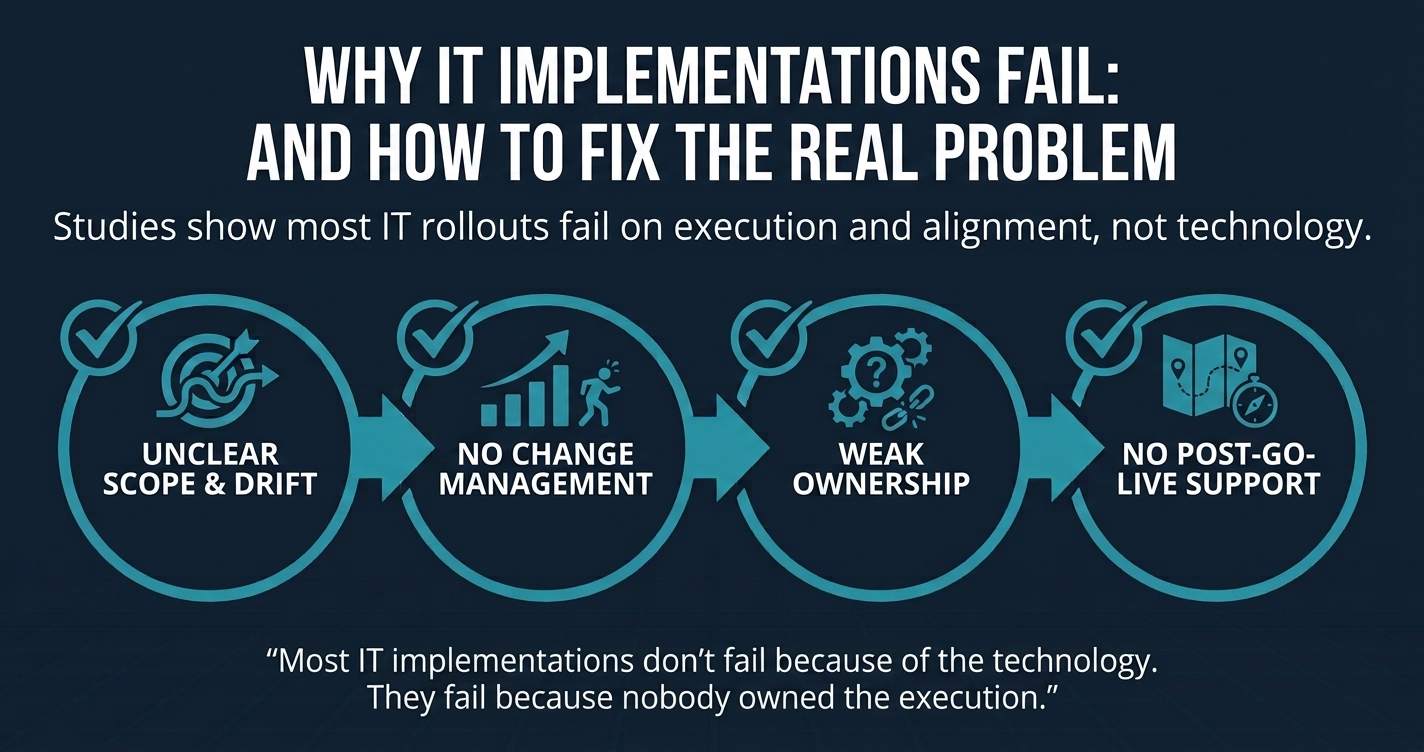
1. Unclear scope and drifting requirements
Every implementation starts with a discovery phase. Requirements are gathered, use cases are documented, the vendor builds a solution. Then, three months into the project, someone realizes the original requirements didn't capture a critical workflow. Or the business has changed. Or a new stakeholder enters with a different set of expectations.
Without a structured scope management process — with clear change control, documented decisions, and stakeholder sign-off at each milestone — implementations drift. Scope creep adds cost, time, and complexity until the project collapses under its own weight.
2. Change management as an afterthought
The most technically perfect implementation fails if users don't adopt it. And users don't adopt systems they weren't involved in choosing, don't understand, and weren't trained on.
Change management isn't a training session two weeks before go-live. It's a continuous process that starts the day the project kicks off: communicating the why, involving key users in design decisions, addressing concerns before they become resistance, and measuring adoption after launch.
3. No single point of accountability
Most failed implementations have a sponsor — a senior executive who championed the initiative — and a vendor project manager who tracks milestones. What they're missing is an internal owner: someone who understands both the business requirements and the technical constraints, who can make decisions quickly, and who is accountable for the outcome.
When accountability is shared across a steering committee, nothing gets decided fast enough. Vendors fill the gap with their own judgment, which may or may not align with what the business actually needs.
4. Data migration underestimated
Organizations consistently underestimate the complexity and time required to migrate data from old systems to new ones. The data is never as clean as expected. Formats don't match. Fields that were optional in the old system are required in the new one. Records have been duplicated, corrupted, or simply never maintained.
A realistic data migration strategy — with time allocated for data cleansing, mapping, testing, and validation — is non-negotiable. Projects that treat it as a final step before go-live always pay for it in delays and post-launch failures.
5. The vendor leaves at go-live
Go-live is not the end of an implementation. It's the beginning of the critical adoption phase. Issues surface that didn't show up in testing. Users fall back to old habits. Workarounds emerge that bypass the system's logic and create new problems downstream.
Without structured post-go-live support — internal or external — most of the value the implementation was supposed to deliver never materializes. The system gets used at 40% of its capability, and two years later someone proposes replacing it with something newer.
"Most IT implementations don't fail because of the technology. They fail because nobody owned the execution."
What good implementation management looks like
A well-run IT implementation isn't complicated. It requires:
- ✦A clear, documented scope with a change control process that prevents drift
- ✦An internal project owner with authority to make decisions and accountability for the outcome
- ✦A change management plan that starts at kickoff, not at go-live
- ✦A realistic data migration plan with time, resources, and testing cycles allocated
- ✦A post-go-live stabilization period with dedicated support and adoption monitoring
This is what AlignIQ provides: not a generic methodology, but hands-on project management from scoping through stabilization — staying through implementation until the system is actually working and actually being used.
Planning an IT implementation and want to avoid these pitfalls?
Schedule a Consultation