When most people hear "Lean" or "Six Sigma," they picture assembly lines, production schedules, and defect rates measured in parts per million. The methodology was born in manufacturing — Toyota, Motorola, GE — and that's where it built its reputation.
But waste isn't only a factory problem. Every organization has it: in procurement cycles that take three weeks when they should take three days, in onboarding processes that require five approvals for a simple request, in customer service workflows where the same information gets entered into four different systems. These are manufacturing problems in office clothing — and Lean Office solves them the same way.
What Lean Office actually means
Lean Office is the application of Lean principles to administrative, service, and knowledge work environments. The goal is the same as in manufacturing: eliminate non-value-adding activities, reduce cycle time, and build processes that are reliable and repeatable.
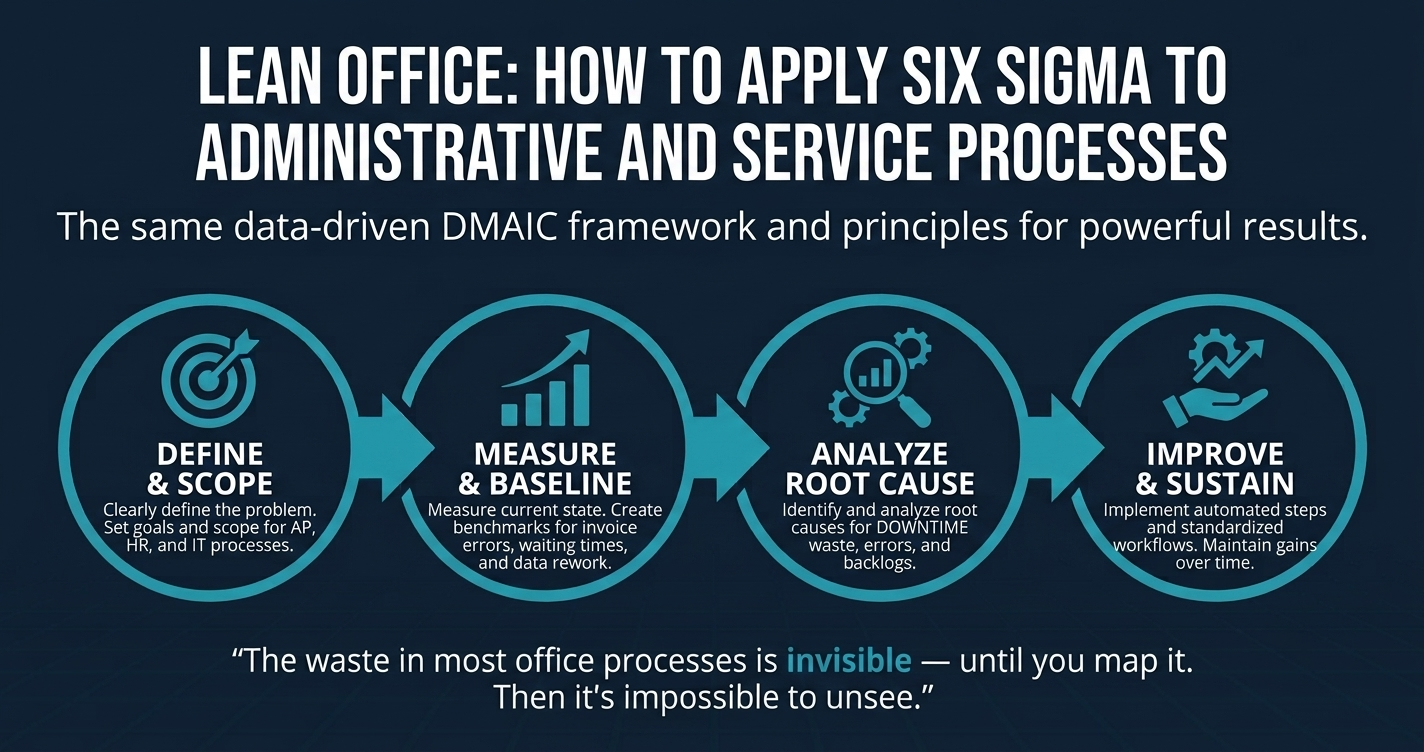
Six Sigma adds a data-driven layer: instead of fixing problems by instinct, you define them precisely, measure them, analyze root causes, implement solutions, and control the results. That framework — DMAIC — works just as well in an accounts payable department as it does on a production line.
The DMAIC framework applied to office processes
The eight wastes in office environments
Lean identifies eight types of waste (DOWNTIME). In office processes, they look like this:
- ✦Defects — errors in invoices, contracts, or data that require rework and correction
- ✦Overproduction — reports nobody reads, approvals nobody uses, updates nobody needs
- ✦Waiting — work sitting in someone's inbox for days, decisions stalled on unavailable approvers
- ✦Non-utilized talent — senior people doing work that a system or junior person should handle
- ✦Transportation — information moving between too many people or systems before a decision is made
- ✦Inventory — work-in-progress piling up, backlogs that grow faster than they're cleared
- ✦Motion — unnecessary clicks, switching between systems, searching for information that should be centralized
- ✦Extra processing — entering the same data in three systems, formatting reports that are immediately re-formatted by the next person
Where to start: value stream mapping
The first step in any Lean Office project is value stream mapping — drawing the current state of how work actually flows from request to delivery. Not how it's supposed to flow. How it actually flows.
This almost always reveals surprises: steps that add no value but have always been done, approvals that exist for a reason nobody can remember, handoffs that add days to a process that should take hours.
Once the current state is visible, you build the future state — the process as it should work — and use DMAIC to close the gap systematically.
Real results in non-manufacturing environments
Applied correctly, Lean Office produces the same kind of results as manufacturing Lean:
- ✦Procurement cycles reduced from weeks to days by eliminating redundant approvals and automating routine steps
- ✦Customer service response times cut by 40–60% through standardized response templates and escalation logic
- ✦Finance close cycles shortened by mapping and automating reconciliation steps that were being done manually
- ✦Onboarding processes redesigned from a two-week ordeal to a structured three-day program with no information loss
"The waste in most office processes is invisible — until you map it. Then it's impossible to unsee."
The methodology isn't complex. What it requires is discipline — the willingness to look at processes as they actually exist, measure what's actually happening, and implement changes that stick. That last part is where most improvement efforts fail: the analysis is done, the recommendations are made, and then nothing changes because nobody owns the implementation.
Ready to map and improve your office processes?
Schedule a Consultation